Exploring Polar Bear Research as Ethical Space, Practice and Process of Engagement: Knowledge-land-scape: Difference between revisions
No edit summary |
No edit summary |
||
| (21 intermediate revisions by 4 users not shown) | |||
| Line 1: | Line 1: | ||
Welcome to the knowledge-land-scape | Welcome to the knowledge-land-scape. | ||
This space extends the work of Saskia de Wildt’s [https://qspace.library.queensu.ca/items/b962c2ad-0eb9-46c7-a428-2ebc7e63752e| '''PhD dissertation'''], “Encountering the Great White Beast: Polar Bear Research as Ethical Space, Practice, and Process of Engagement.” | |||
What does it mean, materially and practically, to ethically reconciliate Inuit Qaujimajatuqangit (the Inuit Knowledge system) and western sciences, within community-based polar bear research? | |||
Enter here | In this Knowledge-Land-Scape you can choose among three narrated pathways to engage with that question. However, like all community-based research, these journeys will not be straightforward. You may run into ice-pressure ridges, shipwrecks and shapeshifting beasts, as well as -depending on how you respond- plenty of landmarks and vistas, that help you orient and gain emergent insights, as you make your own way. | ||
<span class="next_choice"> Enter here </span> | |||
Latest revision as of 19:43, 28 November 2025
Welcome to the knowledge-land-scape.
This space extends the work of Saskia de Wildt’s PhD dissertation, “Encountering the Great White Beast: Polar Bear Research as Ethical Space, Practice, and Process of Engagement.”
What does it mean, materially and practically, to ethically reconciliate Inuit Qaujimajatuqangit (the Inuit Knowledge system) and western sciences, within community-based polar bear research?
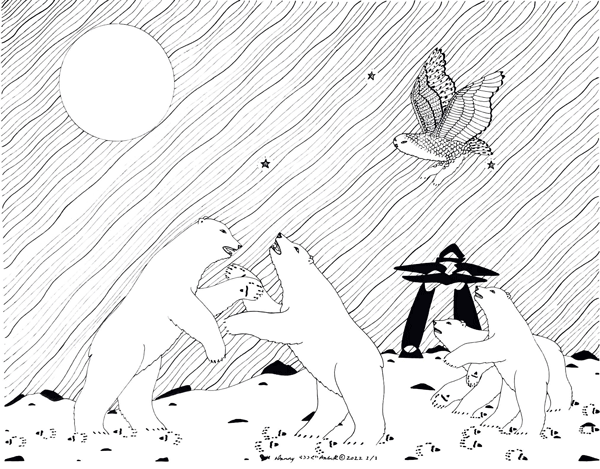
In this Knowledge-Land-Scape you can choose among three narrated pathways to engage with that question. However, like all community-based research, these journeys will not be straightforward. You may run into ice-pressure ridges, shipwrecks and shapeshifting beasts, as well as -depending on how you respond- plenty of landmarks and vistas, that help you orient and gain emergent insights, as you make your own way.
Enter here